Showing posts with label Personal Protection Dogs. Show all posts

Thursday, August 7, 2014

Is Your Dog Fat ?

CCPROTECTIONDOGS.COM
Today, one of the most dangerous health problems facing dogs is obesity. It is your job as a responsible protection dog owner to do something about it. Dogs that are overweight are known to live unhealthy and shorter lives. Extra weight creates a unneeded stress on bones and joints, which could lead to arthritis problems. Dogs that are overweight usually are less able to exercise and do daily activities comfortably, because it becomes much harder for them to breathe. They are less able to resist infections, and they may be at a larger risk for problems during surgery, compared to healthy Guard Dogs.

There are many health problems that may develop due to obesity. One is Joint or Locomotion difficulties, this is when extra pounds and stress causes the the joints, bones, ligaments and muscles to become aggravated. This could in time lead to larger problems such as arthritis, hip dysplasia, and spinal disc disease. Heart and Respiratory disease is another health problem triggered by obesity. It is when excess fat tissue in the chest cavity and around the heart muscles. This causes the heart and lungs to work harder to simply provide the correct amount oxygen and circulation. Overweight personal protection dogs are also more prone to diabetes, pancreas inflammation, and liver disease. Heat Intolerance is when excess fat makes it more difficult for the dog to tolerate heat, causing them to feel uncomfortable quite often. Also skin problems can occur when rolls of skin build of fat deposits, they can often hold dirt and bacteria.

Your Protection Dogs will most likely become overweight when they are not exercised well enough, and from eating more food than is required. Overeating can cause your dog to become greedy, bored, and overfeed often. If you feed your dog leftovers or give them treats a lot, cut back significantly because this behavior leads to obesity in dogs. You can tell if your guard dog is overweight by a simple procedure. Place a flat palm of your hand and feel their ribs, if you have a difficulty feeling the ribs, then they are most likely overweight.


If you discover that your dog is overweight, start by taking them to the vet to have them set a goal for your dog and recommend how much food he should eat each day. The food that you choose for your dog should satisfy their appetite but also contain the vitamins and minerals they need. Keep in mind that a gradual transition from their old diet to the new one may be needed. Do this by feeding them a mixture of the two and increasing amounts of the new diet, while slowly decreasing. Regular exercise is needed to increase the amount of calories they burn, do this by taking them for a daily walk or run. If your dog is old or in poor health, check with your vet first to make sure increased exercise is safe. Your Personal Protection dogs may not lose the weight as quickly as you might think, so just be patient and keep sticking with the new routine. Eventually your German Shepherd, Belgian Malinois, or Dutch Shepherd will be happier and healthier, and you will have helped them increase their quality of life.

Wednesday, August 6, 2014

Senior Dogs

CCPROTECTIONDOGS.COM
As your Personal Protection Dogs gets older they begin to go through different physiological and physical changes. It is your job as a responsible protection dog owner, to make sure that they are provided with the proper nutritional needs to keep them healthy. Senior dogs will require a well balanced diet, which is lower in calories but still containing protein and fat. There are specially formulated senior dog diets that help to create a feeling of fullness. A diet that is higher in fiber, is the type of diet they will benefit from greatly. This is because older dogs are more prone to developing constipation, so they require a diet with 3% to 5% fiber. A tip to help increase fiber in their food is to add wheat bran. Along with their special nutrition needs, senior dogs can be given supplements which will help to supply them with some needed nutrition. A daily supplement like glucosamine and chondroitin, will help to support their joints. Any deficiencies that can develop can be prevented by a vitamin and mineral supplement. Extra antioxidants are also a good way to improve their diet.

Some senior Protection Dogs may suffer from lack of weight gain and disinterest in food. If you notice your German Shepherd, Belgian Malinois, or Dutch Shepherd guard dog not eating well and becoming too thin then you should take them to the vet to be examined. If no signs of any type of diseased come up then you must try to get the dog to eat. Many older dogs have a hard time chewing large hard kibble, so try giving them smaller pieces that is moistened with water. You could also try adding broth to the food, to give it more flavor and become more appetizing to them. Some dogs prefer cat food and will eat it eagerly. However, cat food is high in protein and should be avoided, if possible. Formulating a homemade recipe with milk eggs, boiled, rice, vegetables, chicken, etc could be very beneficial to you dog's nutrition. Do not try and create one yourself however, because the correct amounts of vitamins and minerals is crucial. Instead have ask your vet which type of homemade diet would be best for your dog. As your  Executive Protection Dogs grows older, their needs change and it is your responsibility to take care of them properly.


Monday, August 4, 2014

How to Deal With A Blowing Coat With Your Dog

CCPROTECTIONDOGS.COM
As a Personal Protection Dogs owner, it is important to know how to properly groom your animal. If you are the loving owner of a German Shepherd, it is a good idea to understand their grooming needs. German Shepherds are one of the few breeds that will "blow their coat", this process is often referred to as a blowing coat. The dogs who undergo this process, typically do not shed throughout the year. Instead, their undercoats will shed drastically about twice a year and is often thought as a fur explosion. The period of their blowing coat will last about two weeks. The vast amount of dog hair that is shed within these few weeks can sometimes be alarming. It could easily fill several garbage bags depending on you dog, and note that this process is typically much more severe in females. This intense shedding period will require you to brush your guard dog quite often. If you do not follow through with this, you will find large clumps of hair everywhere. At this time grooming can be very challenging so it is important to understand how to handle it in the best manner.


It is important to know when your German Shepherd's coat will begin to "blow", a good sign is when small clumps of hair begin to fall out all at once. To begin the grooming process, start by buying a brush called an undercoat rake. The tines in this brush will make it much easier to remove large clumps of hair. Make sure that the rake you buy had teeth long enough to reach down to the skin, a longer rake is required for dogs with longer hair. However be careful not to use one that is too long for dogs with short hair because you could risk hurting them. Bathe your German Shepherd dog every few days, a special blower can be used to help remove some of the fur as well. It is a good idea to keep your dog off of the couch, because the large amounts of fur they are losing will likely end up stuck to it. Also vacuuming every day to every other day will keep the large clumps of hair from ending up all over your house. A good piece of advice is to brush your German Shepherd outside, this will help to keep your house cleaner and make brushing a lot easier. Overall, during your Protection Dogs time of blowing their coat, brushing them as much as you can is the key to minimizing the extreme amounts of fur they will lose.

Friday, August 1, 2014

Will a Corso Make a Good Guard Dog ?

CCPROTECTIONDOGS.COM
The Cane Corso is a large molosser type breed of dog with a muscular build. It has a square muzzle that is typically about as wide as it is long, and naturally drooping ears. The Cane Corso is commonly seen with cropped ears and a docked tail, although the controversial practise of docking tails and cropping ears is discouraged in many dog shows, and has been made illegal in several countries. The coat is short and smooth with black and fawn being the most common of several colour variations.

The Cane Corso was originally bred in Italy as a working dog where it was used both for hunting, as well as guarding livestock. It's name comes from the Latin "Cohors", meaning "guardian". Like many European breeds of dog, the Cane Corso nearly vanished after the Second World War, but has been making a steady comeback due to th constant efforts of dedicated enthusiasts who have been working to revitalise the breed since the 1980s.

Relative to many other breeds, the Cane Corso is exceptionally intelligent and easy to train. However, while they have a long history of guarding livestock against wild predators, this does not always translate to the ability to guard against criminals as a  Executive Protection Dogs or a Personal Protection Dogs. For work as a guard dog today, it is best to stick with proven working breeds, such as the German Shepherd or Belgian Malinois, who have demonstrated clearly that they posses the nerves required of a true Guard Dogs.


Thursday, July 31, 2014

How to Give Your Dog Medicine

CCPROTECTIONDOGS.COM
For some reason your protection dog may need to take medications, weekly, monthly, or even daily if certain health problems develop. Giving dogs medicine can be a process that creates a lot of anxiety for both you and your Personal Protection Dogs so it is important for you to know how to properly go about it. If you develop a routine for giving them their medication it will greatly decrease the anxiety. Here are some tips that will make medicine time much less stressful for the both of you.

First, your veterinarian will let you know whether or not your guard dog's medication can be given with food, or taken on an empty stomach. If the tablet or capsule medicine can be taken with food then you can make what is called a "meatball". A meatball is when you place the pill inside the center of a small ball of food, such as canned food or cheese. This will obviously disguise the pill and make your protection dog excited to eat it. It is a good idea though to test this meatball trick first to see if your dog chews or gulps it whole. Most dogs gulp the whole thing, but if they do chew it there is a chance of them finding the pill and spitting it out. If they spit it out the tablet or capsule may have become partially dissolved and hard to handle, which could waste that dose of medicine. Also, if the Guard Dogs bites into the pill, it will likely leave a bad taste in their mouth making it harder to give them medicine a second time.

If your dog's medicine can not be given with the meatball, there are other ways to make the process much easier. The medicine given to you by the vet will most likely be in pill, capsule or liquid form. Being that you can not conceal the medicine your dog will become much more anxious and harder to handle. Start by holding your protection dog's head from the top using your less dominant hand. Then tilt their head backwards, and gently fold their upper lip over their teeth as you open their mouth. This will protect your hand from getting bit if they do decide to bite down, because they will end up biting their lip instead. Next place your thumb on the roof of their mouth, and take the pill in your other hand. Drop the pill or capsule as far back over the tongue as you possibly can. Immediately close their mouth and blow on their nose, this will encourage them to swallow. If you have to give your guard dog liquid medication, take the dropper and squirt it into the pouch between their teeth and cheek. Then try and hold their mouth closed and stroke their neck or blow on their nose to encourage them to swallow. Liquid medicine could possibly enter the dog's windpipe, to prevent this from happening do not tilt their head backwards. Although giving your protection dog medicine may be stressful, it is an extremely important factor to keep them healthy.

Remember if you need to give your German Shepherd, Belgian Malinois, or Dutch Shepherd  Protection Dogs medicine it is not a big deal and by following these simple tips you will be helping your dog in no time.


Wednesday, July 30, 2014

Training the Send Out Exercise in Schutzhund

CCPROTECTIONDOGS.COM
Schutzhund is a dog sport originating in Germany as a way to test the working ability of German Shepherd dogs during the early 1900's. Since then, it has involved into a popular sport, and is enjoyed by canine enthusiasts worldwide. The sport itself offers titles to dogs who compete favorably. Teams of handler and dog can compete for specialised titles that focus on one specific area, but the standard Schutzhund titles demand proficiency in three areas: tracking, obedience and protection.

The purpose of obedience is to test a dog's loyalty, intelligence and ability to be trained. Obedience exercises are performed in all levels of Schutzhund training, and are especially important during the preliminary Begleithunde (BH) stages. One such exercise is known as the "send out" exercise. While the basic concept of Send Out is fairly simple, this exercise is considered one of the more difficult to train for, especially for inexperienced handlers. In the exercise, the handler gives a "send out" command (typically "voraus"), to which the dog must respond by running in the direction signalled by the handler. After about 30 paces, the handler gives the "platz" command, to which the dog must respond by immediately stopping its run and entering a down stay.

As with all distance exercises, it is best to start training at short distances, and gradually increase the distance until it is above 30 paces. Before training the send out exercise, it is important that the dog already be trained for to down stay with the platz command. Begin the send out training by having the dog simply run out, and then gradually add in the platz command. Many trainers begin training by placing a toy in the field and having the dog run to the toy. However, the effectiveness of using a toy is debatable. Regardless of how training begins, one should keep in mind that no toy or object will be present in the Schutzhund ring during judging. Speed is important in this exercise, so it is important that you train for the exercise when your dog is well rested and has energy.

Whether you have a German Shepherd,  Belgian Malinois, obedience is the most important factor in successful training. If a dog cannot consistently follow basic commands, there is no way it will be able to complete complicated protection exercises. One should also keep in mind that Schutzhund training is effective only for sporting dogs. If you want a true Protection Dogs, you need a dog that has been trained specifically for real-world protection from the very beginning.


Friday, July 25, 2014

Bark and Hold Exercise in Schutzhund

CCPROTECTIONDOGS.COM
Schutzhund is a dog sport that is practised by canine enthusiasts in Germany, the United States, and many other countries worldwide. It began in Germany as a way to test the ability of working German Shepherd dogs during the early 1900's, but has since grown into a popular sport with dedicated followers from all over the world. To the average spectator, the sport of Schutzhund may be indistinguishable from real protection work, but when it's time to invest money in a dog who is expected to protect oneself and ones family, knowing the difference between a sporting dog and a Personal Protection Dogs is invaluable.

There are many Schutzhund exercises that fail to properly train and prepare a dog for real life scenarios, but one of the worst, by far, is the Bark and Hold exercise. In this exercise, a decoy will hide himself behind a two-sided structure known as a blind. The decoy wears a bite sleeve over one arm, and holds a stick in the other. The dog is trained to corner the decoy inside the blind, and bark aggressively for a length of time. Eventually, the dog is given the signal to take a bite. During the bite, the decoy will strike the dog with the stick in an attempt to distract and disorient it.

Amongst true protection dog trainers, this exercise is given another name: Bark and Die. As grim as this may sound, the reality is that Schutzhund dogs are being trained to make several mistakes in this exercise. In a life or death situation, these mistakes could have terrible consequences. The first big mistake is that the dog is trained to stand and bark in front of a man holding a weapon. The idea behind this is simply absurd. The reality is that an armed criminal is not going to stand idly by while a protection dog barks at him; he is going to attack. The second big mistake is that once the dog takes a bite, the weapon arm is not targeted. Targeting the weapon arm is absolutely essential, as it prevents the criminal from fighting back. A real criminal will not be softly hitting the dog with a small stick; he will be attacking with a real weapon. In a dangerous situation, these mistakes can not only cost the dog its life, but could also cost the lives of the human beings it's protecting as well.

Whether you're looking to purchase a German Shepherd, Dutch Shepherd or Belgian Malinois as a protection dog, it is vital that you understand the difference between a sporting dog, and a real Protection Dogs. Schutzhund is just a sport, and a dog trained in Schutzhund simply cannot be depended on to protect the lives of you and your family.


Thursday, July 24, 2014

Can You Catch a Disease From Your Dog?

CCPROTECTIONDOGS.COM
There has always been the question of whether or not you can catch a disease from you protection dog. Almost everyone is familiar with stories of rabid dogs and just by hearing the word rabies, they are stricken with fear. Rabies also, referred to as a zoonotic disease, is virus that has the possibility of infecting almost any mammal, including dogs. It lives in the saliva of the animal and is transmitted typically by bite wounds. If the virus is not treated, it will attack the nervous system. Personal protection Dogs infected with rabies begin to show a change in temperament, and act rabidly. Zoonotic diseases can be transmitted from a wild or domesticated animal to a human, and vice versa. Since there is so much concern, it is obvious that there is definitely a potential for you to catch a disease from your Personal Protection  Dogs .

There are also other ways for you to catch a disease from your dog besides Zoonotic Disease. Even if the dog does not appear to be rabid, he could still have a disease that you are not aware of. For example a parasite such as hookworms could be present in the saliva or feces of the protection dog, and there's no way for you to know that before hand. The hookworm could easily spread to you or your child if the dog happens to lick you. This shows how important it is for you to give you protection dog vaccines for worms, and have regular check-ups.


Rabies, hookworms, salmonella, fleas, lime disease, roundworms are all examples of zoonotic diseases that can be caught from your animal. The best solution is to take your protection dog to the vet for regular check-ups and vaccinations. It is a good idea to never handle feces directly. Make sure to always wear gloves when handling your dog's feces, and make sure to pick up any feces in your home quickly to prevent your child from coming in contact with it. Wash your hands frequently when handling any dog, especially unfamiliar ones. You have very little to worry about concerning catching a disease, just always use caution and common sense when handling Protection Dogs.

Friday, July 18, 2014

Bathing Your Dog

CCPROTECTIONDOGS.COM
In order to maintain your personal protection dog's hygiene you need to bathe them when necessary. It is important to know some helpful facts and tips before bathing them, in order to make the process easier, faster, and all around more efficient. Do not bathe your protection dog too often because that will take away healthy oils found in their coat and skin, which will lead to scratching and irritation. Also too much bathing can soften your protection dog's coat and reduce its insulating qualities. The frequency of bathing your dog is mostly determined by the breed and activities the dog is involved in. Dogs that spend a lot of time outside, engaged in activities that are exposed to dirt and bugs will typically require more bathing. Usually every six weeks or more frequently, if they become overwhelmingly dirty. Other dogs only need to be given a bath every couple of months, or less. Also, to help keep your dog clean between baths, brush them thoroughly and preferably daily. By brushing them daily it will benefit their coat, skin and will lead to your dog looking and smelling good.

Being prepared and knowing what to do will help to make the bath much less stressful for both you and your Personal Protection Dogs. The bath will go much more smoothly if you introduce your dog to the idea of bathing first. You can do this by letting them sniff the comb, brush or clippers, and praise them once they become less timid around the tools. Also, let your dog become use to the sound of running water. Most dogs will get scared by being in the bathtub, they usually jump around, slip and fall. You will more than likely spend most of the time trying to get them to stay inside the tub, and in the process get even wetter than them. Instead of going through this miserable task, try bathing your dog outside. Since they are most likely a larger dog breed, such as a German Shepherd, this will make the bath less stressful for them because they are not in a small confined space. Simply hook their leash up somewhere, so they do not have a chance to run off and use a hose and a bucket. If it is colder weather, another place that is better than the tub is the shower. This will work especially well if you have a hand-held shower head. Your personal protection dog will feel much less stressed standing on a firm surface rather than in a tub full of water.


Before you begin to bathe your protection dog, there are also some important things to know. One thing is to carefully brush out any mats, or tangles because it will be harder to do this once the fur is wet. Make sure you wash their face with a wash cloth instead of pouring water over their face, because his the inside of his ears shouldn't get too wet. If you can, use a good dog shampoo that will benefit their coat and skin. After lathering on the shampoo, and making sure they are completely clean, it is time to rinse. Shampoo residue will lead to itching, so make sure that it is all off, and avoid washing it into their eyes. If your are giving your dog flea bath it is extremely important to start with their face and ears, or else tons of living fleas could end up inside the dog's ears. When you are finished, try squeezing any excess water from your Protection Dogs fur and then wrap them in a large towel to gently rub dry.

Wednesday, July 16, 2014

How Dogs Eat

CCPROTECTIONDOGS.COM
Consuming food or as many refer to as eating, is something that all living things must do to survive. All animals have different ways of eating, and to some people the eating behavior of a guard dog, or any other dog for that matter may seem a little strange. However, to the dog this is the most comfortable way of getting the food into its stomach. "Bolting", it the term used to describe the normal swallowing pattern for a guard dog. There are certain steps that a dog goes through while bolting. First, the dog picks up a piece of food with its teeth, and then tosses the piece of food onto the top of its tongue with a short, quick thrust of its head. Next, without being chewed the piece of food is rolled to the back of its mouth. When the food reaches the base of the tongue, the food is upward and backward into the esophagus by a reflex of the tongue. After this, the piece of food is finally carried to the stomach.

If a piece of food is too large to be swallowed, the dog will then make it so that it is a swallowing size. The dog will hold the food with its paws and using its front teeth will tear it into smaller pieces. If it is too tough to be torn by using its paws, the dog will resort to another method. The dog will cut it into small enough pieces by using two specialized jaw teeth, called carnassial teeth. These teeth have large shearing surfaces that act like scissor blades, which can cut through practically anything. The can cut through tough surfaces like hide, gristle, muscle, and even bone. Although dogs have powerful jaw muscles that are useful for cutting food into swallowing size, they are use very little for chewing the pieces. This is because dogs have a small amount of teeth and they are not equipped for mastication.


Many guard dog owners believe that each breed should be fed differently. However this is not true because the eating behavior of a certain dog, is the eating behavior of the whole species. It is simply because all dogs eat the same. When feeding your Protection Dogs there are some general considerations that can be made. Dogs are not required to eat food like humans, because dogs do not have hands. Their jaws are suited for biting and cutting, not chewing. Dogs rarely gag because they have few gag reflex nerves at the back of their mouth. Dogs also have very few taste buds on their tongue, but have an amazing sense of smell. Overall when feeding your Personal Protection Dogs it is important to realize that they eat much differently from us and the way they eat is normal for them.

Tuesday, July 15, 2014

The White German Shepherd As a Protection Dog

CCPROTECTIONDOGS.COM
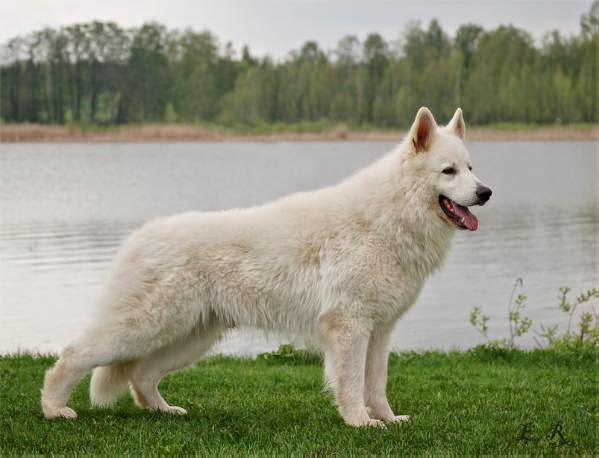
The White German Shepherd, sometimes referred to as just White Shepherd, is a white-coated colour variation of the German Shepherd breed. The white colour variation has been present in the breed since it's original development in the late 1800's by Max Von Stephanitz. Their white coats are mistakenly interpreted as a sign of albinism, but genetic analysis has proven this to be false. The white coat is in fact valid colour variation 'caused by a recessive gene. During the 1930's, the Nazi party took control of breeding standards and practises in Germany. Under new control, white coats became grounds for disqualification and White German Shepherds were not permitted to breed. Following the Second World War, dedicated breeders sought to repopulate and rebuild the German Shepherd breed, but the existing breed standards were kept in place, and white coat variations continued to be seen as a fault.

Today, many kennel clubs around the world continue to regard the White Shepherd as a variation of the German Shepherd breed, and most do not permit them to participate in conformation dog shows. However, the United Kennel Club in the United States has declared the White Shepherd to be a separate breed. While the recessive white coat gene is very rare, it is believed by some that the gene pool is significant enough to warrant the development and identification of White Shepherds as a separate breed. The UKC conformation standard states that a White Shepherd should be pure white in colour, although off-white, cream and light tan coloured coats can be accepted. The dog's nose and paw-pads must remain black.

Aside from the obvious difference in colour, White Shepherds are physically identical to the German Shepherd. White Shepherds can be superb workers and make excellent shepherd dogs and guide dogs. Unfortunately, as the white coat is a recessive gene, the gene pool from which White German Shepherds can be bred is limited. As with any breed that is developed for aesthetic preference over working ability, the limited gene pool can have a negative effect on the overall performance of the dog. It is because of this that a White Shepherd may not have the nerves required for work as a Protection Dogs , or a true Personal Protection Dogs.


Monday, July 14, 2014

The Boxer As a Breed

CCPROTECTIONDOGS.COM
The Boxer is a molosser-type dog of medium size with a square, muscular build. The head is widely recognizable by the broad skull and square muzzle. The jaws are powerful, with a protruding lower jaw which forms a slight underbite. The coat is short and smooth and is most often fawn or brindle with black around the face and muzzle. White markings on the chest and paws are also common. About a quarter of all boxers are born with excessive white markings, some of which cover nearly their entire body.

However, while white boxers are as physically and mentally capable as their fawn and brindle counterparts, white is not an accepted variation of the breed, and they are not permitted to participate in conformation dog shows. Traditionally, all boxers had their ears cropped and their tails docked. Since then, such procedures have been banned in many countries. Several breeders in Britain have developed a variety of naturally short-tailed boxers in response to this ban.

The Boxer breed was developed in Germany during the late 1800s and is a direct descendant of the now extinct Bullenbeisser. The Bullenbeisser had traditionally been prized by hunters for its powerful jaws and bite. They would pursue large prey such as deer and wild boar and hold the prey until the hunter arrived. However, hunters began to favor smaller, faster dogs and the Bullenbeisser was often cross-bred with imported British Bulldogs. This excessive cross-breeding led to the extinction of the Bullenbeisser breed, but also led to the development of the Boxer. The Boxer was popular in Germany as a working dog, and was used by German military as a messenger and Personal Protection Dogs during the First World War. However, it wasn't until after World War II that the Boxer gained international popularity.

The alert nature and strong jaws of the Boxer is well suited to work as a  Protection Dogs. The breed is also intelligent and is sometimes used as a service dog for the disabled, or taken on as part of a k9 police unit. However, the breed is most commonly used today as a family pet and companion.


Friday, July 11, 2014

KNPV And The Bouvier

CCPROTECTIONDOGS.COM
In the Netherlands, during the early 1900's, the Koninklijke Nederlandse Politiehond Vereniging was founded. KNPV was first created because there was not a organization whose goal was to organize training of police dogs. These founders wanted to spread the knowledge of this type of training. KNPV conducts police dog trials and then offers certificates. The certificates that they give out to the dogs are respected and coveted by many around the world. In the early days of KNPV the organization would put through the trials many different breeds such as the Bouvier des Flandres. Other breeds such as German Shepherds, Dutch Shepherds, Belgian Malinois , and Dobermans were also among the breeds tried in the KNPV trials.

Most breeds are not cut out for these types of trials. That is because each trial requires a dog that has great nerves, physical strength, agility and stamina. One breed that fits all of these qualities is the Bouvier des Flandres. The Bouvier des Flandres, often referred to simply as the Bouvier originated in Belgium as a work dog around the farm. The types of tasks they would perform would be things such as cart pulling, cattle herder, and a messenger dog. The Bouvier is powerfully built, rough-coated, and all around a strong looking breed. Its tough double coat protects this breed in all weather, which allows them to perform their best always.


The Bouvier, in today's world are no longer being used for the KNPV program, for they have been bred incorrectly and cannot do the sport of KNPV. This breed is also not a good option to make a good personal protection dog for they are too weak in the nerves. The only breeds that are recommended to handle the work of a Protection Dogs in today's world is the German Shepherd, Belgian Malinois and the Dutch shepherd, and with these breeds, there are only 1% of that can do the work.

Remember that KNPV has always been a sporting title and a certification program for civilians to train dogs. I no way does the KNPV represent a title or a quality of a Personal Protection Dogs. The tests that are put forth through the trials of KNPV do not even come close to all of the qualities, skills, and nerves that a great personal protection dog embody.


Thursday, July 10, 2014

Ear Taping Your German Shepherd Dog


In German Shepherds, standing ears have been a staple of the breed's appearance since the very first were bred in the early 1900's. Unlike other breeds whose ears must be painfully cropped, the German Shepherd has been bred for ears that stand naturally, without the need for unnecessary surgery. Not only do standing ears give the appearance of alertness, but they more effectively channel sound, and are less prone to dirt and infection.

CCPROTECTIONDOGS.COM
Many people take it for granted that a German Shepherd's ears have always stood erect. However, German Shepherd puppies go through a process of growth in which the cartilage in their ears firms up, allowing them to stand. When the puppies are first born, their ears are much too soft to stand on their own. In the majority of puppies, the ears will naturally begin to stand between about 3 to 6 months with no extra help. Unfortunately, some puppies are born with softer ears than others, or cartilage that does not firm up enough for the ears to stand. The process of taping ensures that their ears will set properly, in the shape which was intended for the breed. It should be stressed that the majority of pups will have ears that stand naturally. Ear taping should only be used on pups who have shown no signs of standing ears after about 5 or 6 months.

The process of ear taping should not be left too late. In many cases, starting taping at 7 or 8 months may already be too late. It is important to monitor the growth of your dog's ears, and how they react to noise. Making noise and giving commands will encourage the pup to work the muscles around their ears, and encourage standing. If, by the 5th month, your pups ears have not shown signs of beginning to stand, you should consider taping. While it is recommended to have a vet tape the ears, it can be done at home as well. The most important consideration is to make sure that the right type of tape is used. Only clean surgical tape should be used. Any other type of tape, such as duct tape or scotch tape, can seriously damage your dog's ears. It is also important to purchase a safe adhesive, specifically designed for use on skin. The process of taping the dog's ears is fairly simple. You will need some form of soft cylindrical form to place in the ear-flap. The foam inside of hair-rollers, with the hard plastic parts removed, often work well. Apply the skin-bond glue to the foam, being careful not to apply excessive glue, allow the glue to contact your own skin, or allow the glue to drip into the ear of the dog. Gently place the foam along the inside flap of the ear, in an upright fashion. Leave space between the foam and the ear canal. Tape the ear around the foam in a cylindrical fashion, starting from the bottom. Be careful not to tape too loosely or too tightly, and you should be done.


Whether you have a police dog, a Executive Protection Dogs or a Personal Protection Dogs, healthy ears are an important part of your German Shepherd Puppy's development. If, at any time, you are in doubt about the health your puppy, you should never hesitate to contact your veterinarian for advice.

Wednesday, July 9, 2014

Sign of Cancer with your Dog

CCPROTECTIONDOGS.COM
Cancer, which is uncontrolled growth of cells on or within the body not only is harmful to humans, but it can also develop in dogs as well. As a guard dog owner, the last thing you want to hear is that your dog has cancer. Cancer can often be fatal, if not treated properly and in time. Commonly found in pet animals, the risk for developing cancer will increase with age. Almost half of the deaths of pets over ten years is a result of cancer. Unfortunately, the cause of most cancers is still unknown, making prevention near impossible. Cancer can occur in any location or body system of your guard dog, for example, the skin, stomach, kidney, bladder, brain and bones.

Advance in cancer research have helped to give us the knowledge of knowing different signs to detect cancer before it's too late for treatment. Each type of cancer has its own symptoms and own signs to look for. Skin tumors in dogs are quite common, the most diagnosed are melanomas, lipomas, basal cell tumors and mast cell tumors. If you ever see a lump or mass of any sort on your Executive Protection Dogs , take them to the vet to be examined. Lymphoma is another common cancer in dogs, that affects the digestive system, which will lead to lethargy, vomiting, and diarrhea. This cancer can also affect the liver, resulting in lethargy, vomiting and a yellow shade to the gums and skin. If you notice your protection dog is constantly coughing and having a difficulty breathing, take them to the vet to have a check up. A sign to look for if you are for example the owner of an older female Belgian Malinois is a lump in the breast tissue. It is difficult to make an early diagnosis for abdominal tumors, which include hemangiosarcoma, mast cell tumors, lymphoma, and prostate cancer.

Signs too look for in your Protection Dogs are weight loss, weakness, pale gums, protracted vomiting, continual diarrhea, and abdominal enlargement. If you notice anything that could possibly be these symptoms of cancer, consult with your vet right away, it is better to be save than sorry. This is because if found early, most of these cancers can be cured with surgery, chemotherapy, radiation therapy or a combination. As a responsible Personal protection Dogs owner, pay attention to your dog's health and behaviors, it is crucial to keeping them healthy.


Monday, July 7, 2014

Rules and Title of French Ring Sport

CCPROTECTIONDOGS.COM
French Ring Sport is a dog sport that originated out of France in the early 1900's. It shares a common history with Belgian Ring Sport which also originated around the same time, and the two sports are very similar. The purpose of French Ring Sport, like many dog sports that have come out of Europe, was to test dogs for their character and suitability for work and breeding. Since then, the rules have been changed and refined into a proper sport.
Dogs competing in the sport perform exercises in front of judges who award them a point total based on their performance. Regardless of which title the dog is competing for, it will be awarded a rank of Non Classe, Bon, Tres Bon or Excellent, corresponding with less than 60%, 60-70%, 70-80% and over 80% point totals. However, only dogs that achieve a score of over 80%, and a rank of Excellent, will qualify for the title and be able to compete for more challenging titles in following years.

Before a dog can compete for proper titles, it must pass an introductory test of obedience, intelligence and character known as Brevet. Just as with full titles, a dog must obtain a score of 80% of higher in order to pass and move on to full competition. After the initial introductory tests, there are three levels of French Ring titles simply known as French Ring 1 (FR1), French Ring 2 (FR2), and French Ring 3 (FR3). Each title tests obedience, agility and protection with FR1 offering the least difficult exercises and FR3 being the most challenging. Unlike most dog sports, dogs must compete twice for each level, in front of two different judges. A dog that has passed the first judging in FR1 is considered to be Level 1, while a dog that has passed both is considered to have the full French Ring 1 title. The same is true for both FR2 and FR3.

Unfortunately, while French Ring Sport is commendable as a sport, it is a far cry from real-world protection work. Whether you have a German Shepherd Dutch Shepherd or Belgian Mslinois, it is imperative that you train it for the work it will be doing. Training a dog for sport just isn't good enough for real Protection Dogs or Personal Protection Dogs work.


Tuesday, July 1, 2014

Firearm Exercise in French Ring

CCPROTECTIONDOGS.COM
One of the most important aspects of a good protection dog is good nerves. If you've ever seen a pet get spooked in a loud thunderstorm, you know how loud noises can often throw an animal off-guard. Even most humans jump at the sound of a large bang. For police officers, recognizing the sound of gunfire, being able to remain steady and calm, and being able to act quickly and effectively to neutralize the threat are all life-saving necessities. The exact same is true of Protection Dogs.
In French Ring sport, there is an exercise intended to test the nerves of a competing dog, and how it performs during gunfire. In this exercise, the decoy/helper is given a gun that fires blanks. The dog is instructed to take a bite on the decoy, and the decoy fires the gun twice during the approach. The decoy fires once more during the bite, and then freezes, at which point the dog lets go and begins to guard the decoy. The judge then signals for the decoy to attempt two escapes, during which the dog will take two more bites to prevent escape. Finally, the judge signals to the handler to disarm the decoy and end the exercise.

It is important that Personal Protection Dogs be trained around gunfire, and this exercise certainly accomplishes this. However, French Ring dogs are being trained with a fatal flaw that could end disastrously in a real-life situation. The third shot fired by the decoy is made after the dog has already taken a bite. In a real-life situation, this would be fatal to the dog. A criminal with a gun is not simply going to fire blanks into the air during a real confrontation; he's going to aim at the dog biting him. A true Executive Protection Dogs should always be trained to target the weapon-arm as a first priority. Waiting for the handler to disarm the opponent is simply absurd, and could quickly end in death. The sooner that the gun is out of the criminal's hand, the more of a chance there is that all involved will survive without serious injury.


The Belgian Malinois, and German Shepherds that compete in French Ring exercises are certainly impressive, but when it comes to true, functional protection work, you need dogs that are trained for real protection in real-life scenarios.

Thursday, June 26, 2014

The Importance of Regular Hip and Elbow XRay for your Dog

CCPROTECTIONDOGS.COM
Hip and elbow dysplasia can be found in a variety of animals, including humans. However, the disorder is commonly found in, and associated with canines. Larger and especially active dogs are particularly at risk due to the excess stress put on their limbs and joints.
Dysplasia is an inherited disorder, and diagnosis can be tricky. While some sever cases are recognizable in a dog's infancy, many cases go unnoticed until well into the dog's adult years. Dysplasia is the most common cause for arthritis in canines. The disorder often worsens as the dog ages and can be both painful and debilitating.

Work as a Protection Dogs often involves rigorous exercise. As a result, flaws in the hip joints affecting balance and posture often become apparent far sooner than in less active dogs. Because dysplasia is inherited, dogs from poorly maintained German Shepherd bloodline are often at high risk. Working line German Shepherd breeders need to pay special attention to the hips and elbows of their dogs in order to ensure that they are not introducing dysplacia into their bloodlines.

While your Personal Protection Dogs may not show symptoms of hip or elbow dysplasia for the majority of its adult life, there is still a chance that minor deformations in the joints will worsen over the years with standard wear-and-tear caused by the exercise your dog needs. Regular x-rays of your dog's joints can help you and your vet monitor your Executive Protection Dogs for signs of dysplasia in the joints. For working dogs who may be getting on in their years, signs of hip and elbow dysplasia may be an indicator that it's time to retire your canine to a less active lifestyle.


Wednesday, June 25, 2014

All about Guard Dog Anal Glands

When taking on the responsibility of owning a Personal Protection dogs, it is important to be educated about their health, especially the different types of health problems they could develop. Dogs have two small glands located on both sides of their rectal opening, they are called anal glands. Each gland is filled with a small amount of sickly smelling brown liquid. Each time your guard dog urinates or defecates, a small amount of pressure is applied to the anal glands, and a tiny amount of the fluid is released. Each dog has their own unique scent that is produced from the anal gland. If you have ever wondered why dogs tend to sniff each others rears, it is because they are smelling the other dog's scent. It may seem strange, but this is how your protection dog will learn to identify other dogs. This behavior is as normal to dogs as the behavior of humans shaking hands when meeting someone new.

CCPROTECTIONDOGS.COM
Although it is not common, it is possible for anal glands to form a infection. This happens when the anal gland liquid is not released sufficiently, and bacteria begins to build up. When this infection is left untreated it can turn into an abscess. This abscess can then rupture the skin, which will obviously lead to more complications. It is often believed that dog anal gland problems can be linked back to the quality of pet food that it is given. Cereal fillers are often used in inexpensive dog food brands, and they tend to make the stool soft. If the stool is not able to press firmly on the anal glands, it will not provide enough pressure to release the fluid. That is why you should take the necessary actions to buy a higher quality dog food, that will produce a firmer stool. This will not only help to prevent anal glad problems, but it will more than like be a better food for your Executive Protection Dogs.

If your personal protection dog, for example your German Shepherd does however develop a anal gland infection, there are many signs that you can look for. This infection will make your guard dog very uncomfortable and being able to see the abnormal signs will be simple. One sign is that your dog will be scooting or dragging his rear across the floor. Another sign is if your guard dog keeps licking or chewing near his rectum. Also if your dog's stool becomes soft and mushy. If you notice a foul or fishy smell from your dog's rear, this is also a sign that they may have a anal problem. When you notice one or more of these signs, it is a good idea to take the Guard Dogs in for a check up with their vet. If the infection has not progressed too severely, then the vet will most likely manually express the anal glands. This type of procedure is a job that is better to be left to professionals.


Tuesday, June 24, 2014

Cloudy Eyes in Your Dogs

CCPROTECTIONDOGS.COM
As a dog owner, making sure that your Personal Protection Dogs is healthy should be one of your main priorities and responsibilities. One health problem that may occur for you dog is a cloudy eye or otherwise known as keratitis. Keratitis is the inflammation of the cornea, causing the cornea to become cloudy. The keratitis infection occurs when a bacterial infection complicates the corneal ulcer. The bacteria that most commonly infects the eye is Staphylococcus, Streptococcus, and Pseudomonas. When this happens the eyelids become swollen and matted. Some dogs are more likely to develop keratitis for example, dogs with short noses and prominent eyes and breeds such as the boxer. This infection covers the iris and pupil and limits light to enter the interior of the eye. The inflammation can also be accompanied by loss of the first layer of the cornea or loss of deep layers. At first, the eye might not be noticeable which could lead to trouble diagnosing your dog's keratitis. That is why it is very important to be alert and take your protection dog to the vet if there are any signs.


There are many signs that you can look for in your dog to diagnose keratitis. One sign is if your dog's eye looks red and painful. Another is if the eyes are watery or teary and if the animal squints. Also if they are sensitive to the light or rub at their eyes. The eye might remain closed and discharge could become present on or around the eye and eyelids. And one of the common signs is the eye becoming cloudy. If any of these signs are noticeable, take your protection dog to the vet as soon as possible. Once there the keratitis will be diagnosed through a complete eye examination. The vet will inspect the eye and cornea carefully and a test for the presence of corneal erosions by placing dye into the eye will be done. If keratitis is is diagnosed then certain steps will be taken to treat the infection. The treatment ultimately depends on the cause and severity of the corneal disease. Dogs with deep or rapidly progressive corneal damage may require hospitalization for surgery or frequent medical treatment. If it is not severe then surgery is not needed and antibiotic will be applied. Like any other health problems, be alert for signs of abnormalities in your Protection Dogs, and be prepared to take the necessary steps to keep them healthy.